What Are the Aspects of Judging?
Aspects of Judging
Also available are archives of live broadcasts, where the Program Director goes over the lesson, answers any questions that folks may have and sometimes goes on tangets about other elements of judging. You can find the playlist of broadcasts on youtube.
Click for Translation
While proper translation and localization are among our long-term goals, we are currently offering Google Translate on the page. Please keep in mind that the translation is automatic, which means that specific game terms, names of cards or mechanics, or technical language used to describe the game may not translate well. As with the documents for the game itself, the English page is the authoritative document in case of any confusion or discrepancy.Join the discussion in our Discord and talk with other judges about what you learned, and ask any questions you may have!
Hello there!
Welcome to the Aspects of Judging lessons. As always, I’m your host Jonah, and this elective lesson series is going to cover the Aspects of Judging - just like it says on the box.
When asked about what makes a judge stand out, what skills, talents, attributes, qualities a judge has, a player will likely identify rules knowledge as the primary skill, and more engaged players might call out fixing issues that occur in games (policy) as something that’s important.
However, if you’ve gone through the lessons for L1 or higher, you’ll know that there is a lot more to judging than just rules and policy issues - there’s leadership, logistics, mentorship, and more. Even with that knowledge, though, there isn’t much of a framework to follow. You may know that there are more skills that are important, but it can be difficult to know what the expectations are for your level or for the roles you’re interested in, or even how to get there.
To that end, we’ve collated these skills into six aspects (although they don’t neatly match the in-game aspects). Those six aspects are:

Each of these six aspects has been further divided into more manageable chunks, and those are divided even further, so that there are around a hundred different aspects. Is this excessively detailed for day-to-day judging? Absolutely. But these lessons and aspects aren’t really anything you need to study - a lot of them you’ll already be doing, and doing well, without having a label for it, and that’s great. These lessons just provide a bit more structure and context.
Game & Format Knowledge is pretty clear - it’s your ability to answer rules questions, fix issues that arise, handle game-state investigations, and generally just understand what’s going on in a game. It’s often strongest in judges who are also competitive players, but it’s something that can definitely be taught and learned.
Tournament Operations & Logistics is the actual running of the event. At the local level for weekly play and similar, it’s very light - mostly just making sure that rounds get paired and players get prizes - there’s not a whole lot more that needs to be done. But as events scale up, the number of tasks and the complexities of those tasks also scale up.
Interpersonal Skills & Communication is a very broad bucket - at it’s core though, judging is a customer service role - you’re enhancing the event with your presence, and directly interacting with other people. If you’re not able to communicate rulings, or deal with contentious scenarios, you’ll be limited in your opportunities as a judge. While this is definitely more subjective than, say, the Comprehensive Rules, there are best practices and ways of thinking that can help you improve.
Personal Growth & Accountability is a secret core tenet of the judge program. While we have a wonderful global community and there are always going to be people who are ready and willing to help out, you’ll often be working on your own - being able to continue to improve, even without explicit feedback, is critical to long term success. Furthermore, as an implicit authority in your community, how you handle yourself has a broad impact. It can be difficult to get good at self-improvement, but it’s a skill that we want every judge to become comfortable with.
Evaluation & Mentorship of Judges is closely related to Personal Growth, but instead of your own growth, it’s helping other judges find their way. This community is just that - it’s a communal effort, and while some people may have a larger presence than others, we all help each other improve through our feedback and insight. Whether it’s two judges working together at a large Store Showdown, or hundreds coming together online to help educate each other, it is the collective efforts of education, understanding, and improvement that makes the judge program what it is.
Leadership, Management, & Command is the last core aspect we’ve listed, but so very far from being the least. At the local level, you’re getting half a dozen or a dozen players to follow your instructions, all the way up to managing a team of forty judges and getting a few thousand players to do what they’re supposed to be doing. This is one of the aspects that can change in appearance the most as you advance, but it’s a skill that can be trained, just like every other aspect.
You don’t need me to tell you that Rules Knowledge is important to being a judge. Beyond that, through your own experience, you’ll understand the importance of community at various levels, or why draft procedures are important, what conflict management can assist with, how to perform self-evaluation, or give feedback to another judge.
However, having this shared list of aspects allows you to identify areas of improvement and areas that are strengths. It allows you to begin to think about how these traits interact and intersect, and how they can be applied outside of judging. It allows you to talk with other judges about your goals and what steps you think you need to take to achieve them.
It also allows us to provide guidance on what the expectations are for judges of various levels or roles in a consistent context, so that judges and tournament organizers have more knowledge and can be better prepared for their events.
Beyond that, it allows you to measure where you are, what makes sense for you, and what next steps could look like to find the opportunities you’re interested in gaining.
Some of these aspects may not make sense on a surface level for judges of all levels, but they can and do apply to judges of all levels - just in different ways.
Leadership is very important for a Head Judge of a Sector Qualifier, with a team of fifteen judges working under their authority - they have to manage their team leads and keep the entire event moving in a singular direction.
On the other hand, an L1 running draft night may not have other judges to lead, but they do have to get eight players to draft appropriately - the difficulty of that task may vary based on the players in your local community, but you’re still using the same types of skills that a more senior judge would be employing. Your charisma, your presence, and your ability to give directions are all important in that space, even if they’re utilized differently.
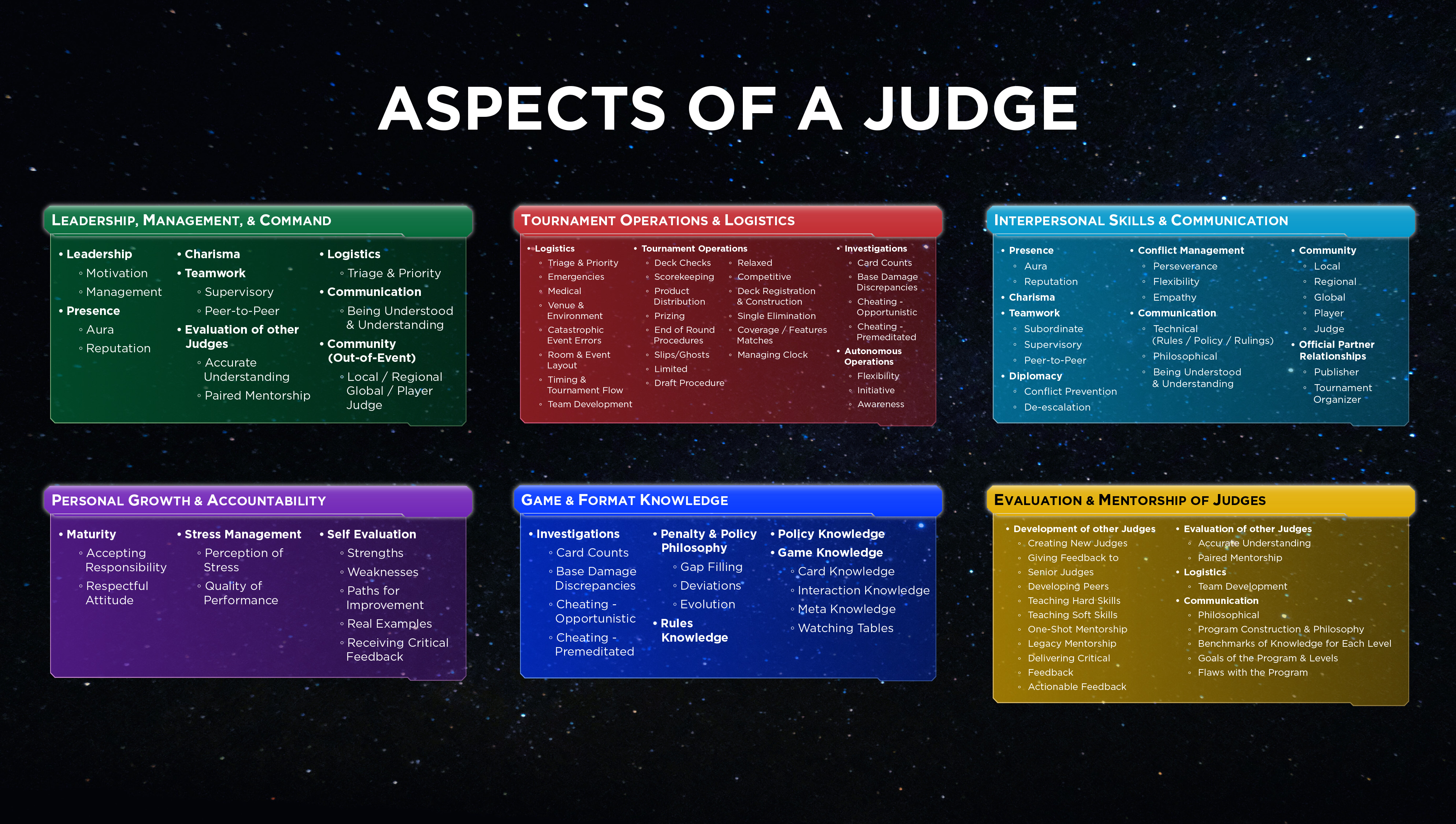
By breaking all of these down into more digestible chunks, by explaining what we mean by “presence” or what is expected by a judge of each level, you’ll be able to better understand what to look for, and what the goals are for each aspect.
I know this was short, and we’re going to try and keep it that way, but I can’t make any promises. Next in our queue is the Game and Format Knowledge - this one is one of the more straightforward and obvious ones, and is fundamental to the common understanding of a judge, but it goes a bit deeper than “know the rules.” But, we’ll get into that next time!
If you’re watching this on YouTube, and you want more lessons in your feed, go ahead and subscribe. Join us after new lessons on twitch.tv/swu_judges for live broadcasts covering the content of these lessons as they are released, and join the Star Wars: Unlimited Judge Program Discord to join the community in discussion of this and much, much more.
Until next time, good luck and have fun!